Field note
The pig is not a mascot
By Andy Jordan · October 22, 2026
Big Tech is making AI cute. I'd rather it make AI approachable.
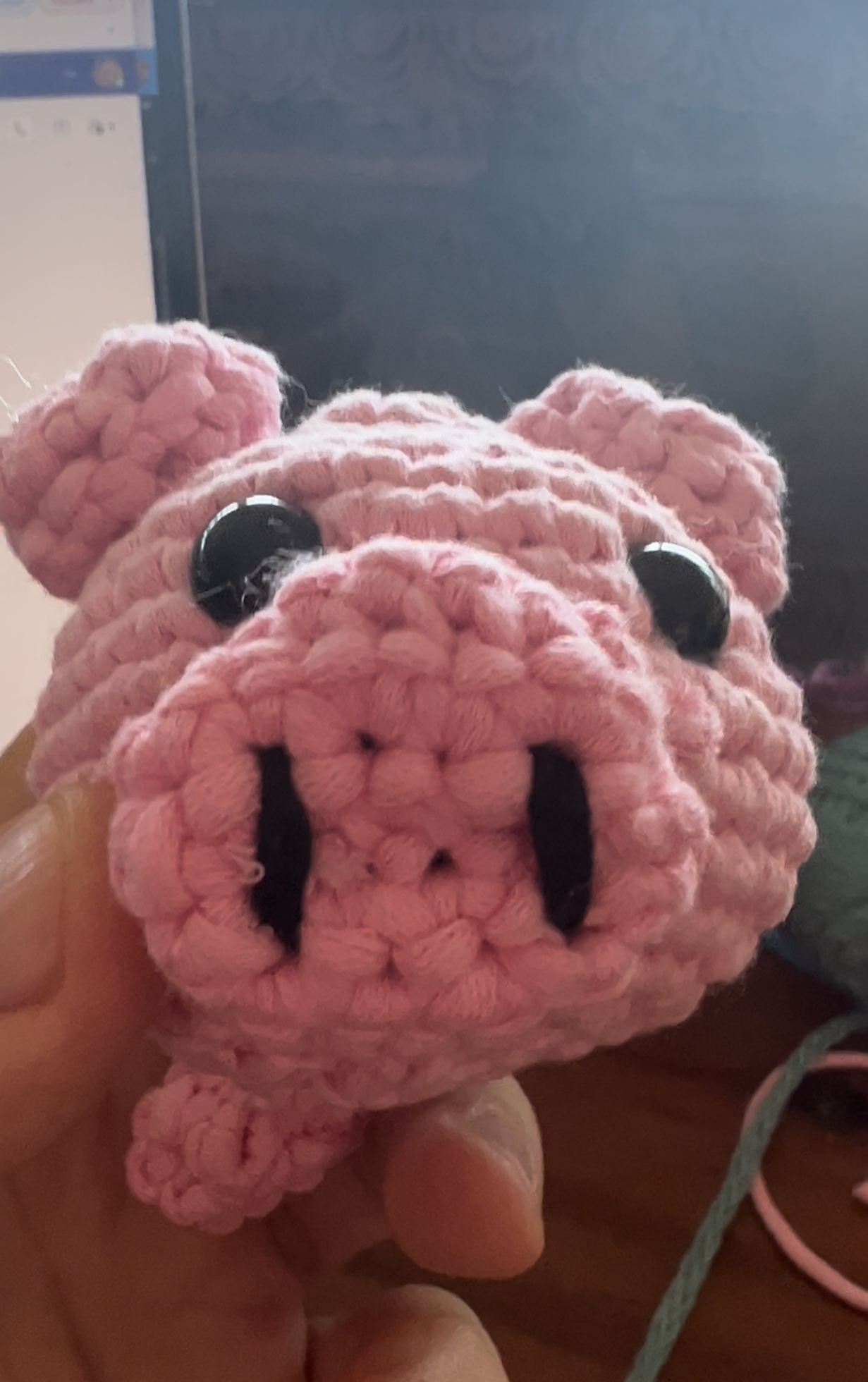
I make cute things. Like this amigurumi pig I crocheted. But it's not a mascot. It doesn't need access to my inbox. It doesn't want my credit card. It just sits on the shelf and makes me happy.
That's a different job than the one the AI industry is giving its fuzzy little mascots right now.
The cute little guys have arrived
Fast Company calls it cutewashing. SpaceXAI launched GrokBot, a series of agents represented by shapes with giant, orb-like eyes. Meta's Muse looks like a fluffy monster toy, and OpenAI's dots look like customizable Pixar characters.
The psychology is solid. Joshua Paul Dale, the Chuo University professor who pioneered "cute studies," says cuteness stimulates the pleasure centers in your brain before you have a chance to think, and research indicates we tend to forgive cute things when they make mistakes. For a technology known for hallucinating, that's a handy shield.
We've also seen this movie before. Buck's Kevin Walker helped design Facebook's "Alegria" illustration style, which got cloned by everyone from Airbnb to Hinge, Google and YouTube, until "Corporate Memphis" became shorthand for Big Tech trying to look authentic while gathering more control over our attention and personal data. If everyone has a mascot, nobody has a memorable one.
I'm all for cute
Let me be clear: I'm all for cute and whimsical in brand. Clay brought in illustrator and animator Hudson Christie, whose handmade, tactile claymation now lives on its website. As he puts it, "I bring imperfection to the brand." Gamma's brand guidelines say it's for everyone from the playful creator to the polished professional, and its headline typeface includes a set literally called Bauhaus, the most playful of the three. TypeSafe named its first model Jev, after Jevons Paradox. Ploy has fun with it too.
Even in enterprise B2B tech, who doesn't like a little cute joy?
But in every one of those cases, the whimsy sits on top of a product that does something clear. That's personality. A plush avatar in front of an agent that wants your bank account is something else.
What's behind the face
To get everything OpenAI and Meta say is possible, you'll need to connect your email, credit card details, documents, text messages, health data and productivity apps to your agent. One tech YouTuber said his Muse agent gave out his home address without permission. It turned out he had granted that permission and just didn't realize it.
That's not a cuteness problem. That's an understanding problem.
Approachable in practice
Rather than make AI cute, we need to make it approachable in practice. Easier to understand.
Average users can't keep up with model releases, or why one is better than the other, or the thousand startups that all do the same thing. A fuzzy little guy doesn't fix that. What does:
- Permissions in plain language. Not a buried "always allow."
- Show the work. Perplexity shows users the AI's status, including what terms it's using to search the web.
- Match the tone to the risk. When an AI is handling a big financial transfer, users don't want a playful interface. They want precise language like "Verifying account routing numbers."
- Be honest about what it gets wrong. When Icelandair searched for the world's worst photographer, it drew 127,642 applicants, and its marketing director said it resonated because people are tired of manufactured perfection. The research backs it up: people can feel more favorably toward a product when a small dose of negative information is added to an otherwise positive description.
Make AI that does more than market
I'm in marketing, so I get the need and joy of having AI automate and make workflows faster. But it needs to be more approachable on its merits.
Here's what that looks like. An 82-year-old in New Jersey used Muse to compare Medicare Part D plans and found one she'd never heard of that could save her more than $6,000 a year. She checked the work and found it accurate. The cute avatar didn't win her over. The answer did.
Or bigger: AlphaFold2 has predicted the structure of virtually all 200 million known proteins and has been used by more than two million people in 190 countries, helping researchers understand antibiotic resistance and enzymes that break down plastic.
Make life easier. Cure diseases. That's the approachability that sticks.
Spoons, shovels, and the jobs AI will replace
In all instances of technological shifts, new jobs emerged to take the place of the jobs technology replaced. Digging ditches? Machines could do it better.
There's an old story, usually told about Milton Friedman, of a visitor watching workers dig a canal with shovels. When told it was a jobs program, he suggested handing them spoons instead. The punchline has been pinned on everyone from Friedman to a Canadian politician to a UK minister of agriculture, and the core of the anecdote was in circulation by 1901. The point holds either way.
MIT economist David Autor found about 60% of jobs in 2018 did not exist in 1940. But an honest view has to include the other half: automation eroded twice as many jobs from 1980 to 2018 as it had from 1940 to 1980, and augmentation didn't add back as many as automation took. New jobs don't show up on their own schedule. Someone has to build them.
Some companies already are. Clay pioneered the GTM Engineer role, and 400+ GTM engineer jobs were posted in a single spring at $160K median salaries.
So maybe instead of making an agent cute, frontier models can spend some time focusing on creating the jobs AI will replace.
How about a startup that does that?
Wait. That's my idea.
It has a pig as a mascot.
So okay, maybe the pig is a mascot after all. But this one comes with a job.
Sources
- Grace Snelling, Big Tech is cutewashing its AI agents, Fast Company, October 8, 2026
- Clay's illustration and the craft of imperfection, It's Nice That
- Gamma brand guidelines
- TypeSafe exits stealth with $40M seed to build AI for software, not people, Dealroom
- Karissa Bell, Don't let the adorable AI agents fool you, Engadget, October 2, 2026
- Practical Interface Patterns for AI Transparency, Smashing Magazine, May 2026
- Meet the World's Worst Photographer, To Vima
- Danit Ein-Gar, Baba Shiv and Zakary Tormala, When Blemishing Leads to Blossoming, Journal of Consumer Research, 2012
- Andrew R. Chow, Meta's Muse AI Is Winning Over Older Adults. Privacy Experts Are Worried, TIME, October 22, 2026
- Nobel Prize in Chemistry 2024 for AlphaFold2 and protein design, Utrecht University
- Quote Origin: If You Want Jobs Then Give These Workers Spoons Instead of Shovels, Quote Investigator
- David Autor on new work, 1940–2018, MIT News
- Clay, CapitalG
- Clay Series C announcement, Clay community